Name changed to protect patient confidentiality.
When I first met Barry, he was living with Parkinson’s disease and had reached a point where even simple daily activities had become incredibly difficult.
His mobility had gradually declined over time. What had once been a short walk to the local shops or coffee shop had become impossible. By the time I became involved, Barry was spending much of his day in bed and required significant assistance from carers to complete everyday tasks.
His family were understandably concerned. They had watched a gradual decline over many months and were worried that Barry was losing both his independence and his confidence.
The Initial Assessment
During my first visit, it quickly became clear that Barry’s difficulties extended beyond simply feeling weak.
Standing up from bed was becoming a major challenge. Walking was limited to only a few steps at a time, coupled with an extreme fear of falling, his confidence had reduced significantly. As is often the case with Parkinson’s disease, reduced activity had created a cycle where less movement led to further deconditioning, which then made movement even more difficult.
Rather than focusing solely on exercises, we looked at Barry’s overall situation and identified practical ways to help him move more safely and more often throughout the day including introducing equipment to support him.
Creating a Plan
We agreed a programme of physiotherapy visits twice each week.
Our initial goal was simple: help Barry move safely around his own home.
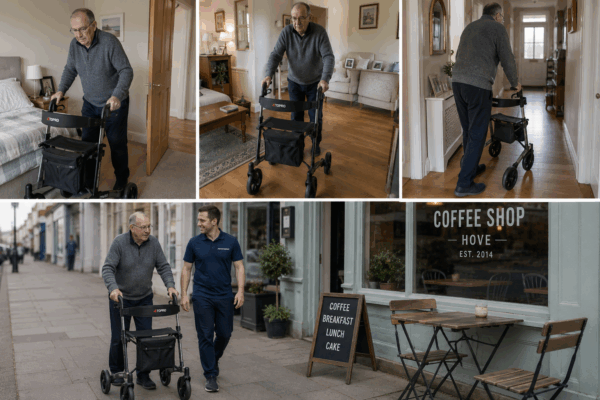
To support this, we introduced a specialised hydraulic walker which provided greater stability and confidence than his previous equipment, whilst this wasn’t cheap it gave him access to the mobility he had lost and a way to maintain his safety.
We also reviewed the equipment he was using within the home. A profiling hospital bed and riser recliner chair helped reduce the effort required to stand and allowed Barry to conserve energy for the activities that mattered most to him.
Alongside this, we set daily walking targets indoors. These were realistic and achievable. Rather than focusing on what Barry could no longer do, we concentrated on small improvements that could be built upon over time.

Building Confidence
One of the most important aspects of rehabilitation is confidence.
Many people assume mobility problems are caused purely by physical weakness, but confidence often plays an equally important role.
As Barry became stronger, he also became more confident in his ability to move around his home safely.
The distance he could walk gradually increased. Transfers became easier. Everyday tasks required less assistance. Importantly, Barry began to believe that improvement was possible, because he could start to see the results he became more determined to undertake the exercise and started setting himself a daily target to beat yesterdays record of lengths of the corridor walked.
Family members and carers played a vital role during this stage by encouraging regular practice between physiotherapy sessions.
Reaching the Big Goal
Early in our work together, I asked Barry what he would most like to be able to do again.
The answer was simple.
He wanted to visit his local coffee shop, this had long been a place where he would meet neighbours and friends and he had felt isolated and depressed since not being able to make the short trip by himself.
For many people, walking 150 metres may not sound like a significant achievement. For Barry, it represented freedom, independence and a return to part of his normal life.
Over the following weeks we gradually increased his walking distance, carefully balancing challenge with safety.
Eventually, Barry achieved his goal, together we walked the 150 metres from his home to his local coffee shop, it took effort but we made it. It was a brilliant feeling to be able to enjoy that first coffee with him.
For the first time in a long while, Barry was able to sit and enjoy a coffee outside his own home, on his own terms, which might seem like a small thing but gave him a significant boost.

The Outcome
By the end of our work together, Barry had:
- Improved his ability to stand and transfer independently
- Increased his walking distance significantly
- Developed greater confidence when mobilising
- Reduced his reliance on carers for some daily activities
- Achieved a meaningful personal goal
- Improved his overall quality of life
Perhaps most importantly, he regained a degree of independence that had previously seemed out of reach.
As his mobility improved, the level of care support required also reduced, helping to lower the ongoing cost of care for both Barry and his family.
Why This Matters
One of the biggest misconceptions about conditions such as Parkinson’s disease is that decline is inevitable and nothing can be done.
While Parkinson’s is a progressive neurological condition, physiotherapy can often make a significant difference to mobility, confidence and independence.
The key is identifying meaningful goals and building a realistic plan to achieve them.
For Barry, that goal wasn’t simply walking further.
It was getting back to his local coffee shop.
Sometimes the smallest goals can have the biggest impact.
If you are concerned about your own mobility, or that of a parent or relative, home physiotherapy may help identify practical ways to improve independence, confidence and quality of life.
To discuss how physiotherapy could help, please get in touch.